SPARCS: How I Think About the Customer Journey
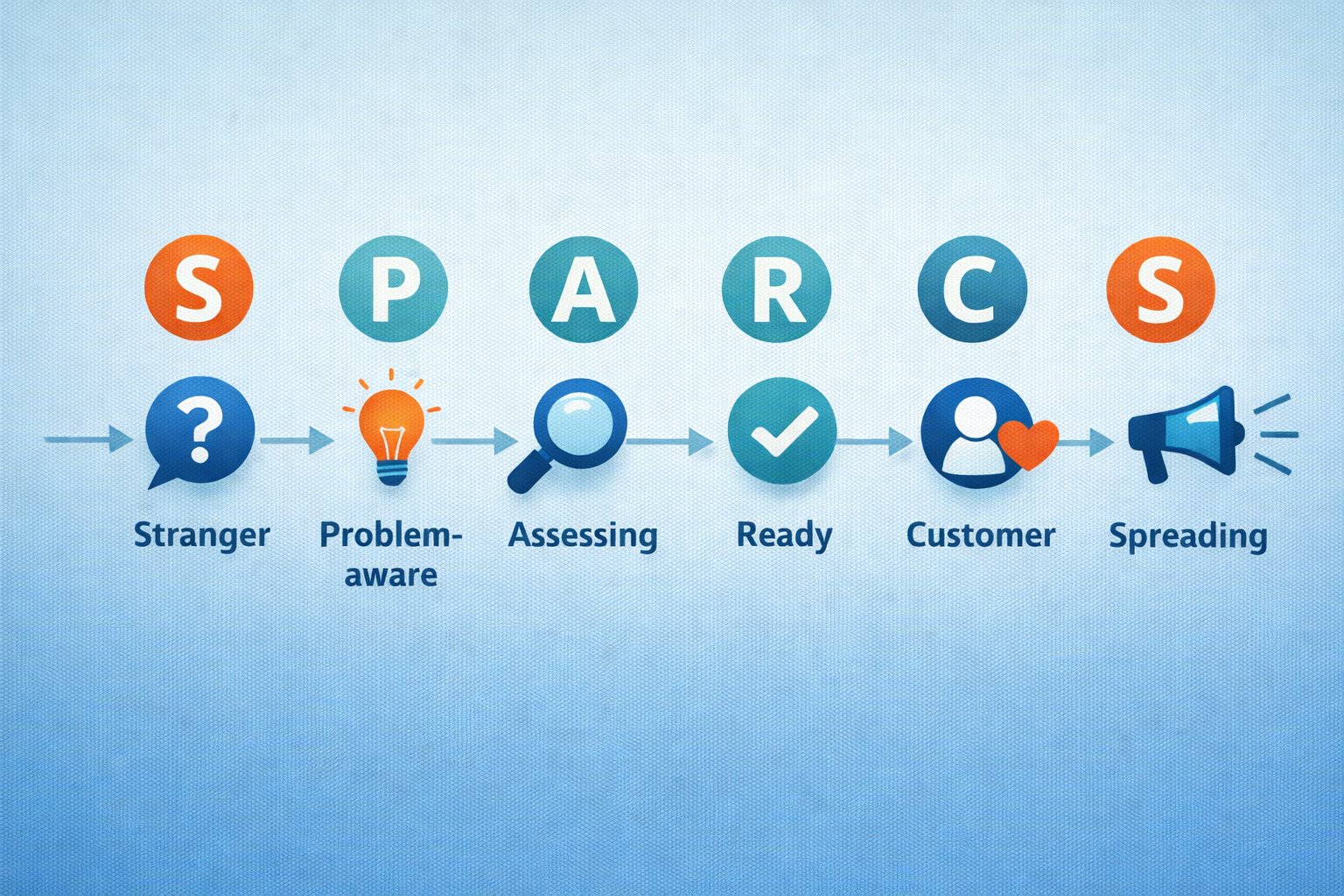
If you zoom out, most of my marketing work is just helping people move through six stages.
I think of it as SPARCS:
S – Stranger (never heard of you)
P – Problem-aware (they feel the pain, you’re barely on the radar)
A – Assessing (actively comparing options, including you)
R – Ready (they’ve chosen you or are right on the edge of committing)
C – Customer (they’re using the product and getting value)
S – Spreading (they’re talking about you to other people)
Different companies slice it differently, but the idea is the same. The mistake I see over and over: one-size-fits-all marketing.
You send the same message to a Stranger and to a Spreader and then wonder why nothing lands.
Here’s how I think about each stage and how marketing should show up.
S – Stranger → Make Them Stop Scrolling
At this stage, you’re fighting pure indifference.
Your job is not to educate them on every feature. Your job is to earn five more seconds of attention.
That means:
A sharp point of view
A specific problem call-out
An immediate “this is for people like you” signal
If I can’t tell who you’re for within three seconds, I’m gone.
P – Problem-Aware → Give Them a Clear Next Step
Problem-aware people are the most fragile. They’re interested enough to click, not committed enough to work.
Your job here is to:
Acknowledge the problem in their language
Answer their obvious “is this legit?” questions
Offer one low-friction next step (video, checklist, demo, quiz)
Not five. One.
If you dump them on a busy homepage and ask them to figure out what to do, they’ll bounce and never come back.
A – Assessing → Arm Them for Internal Conversations
Once they’re assessing you, the real sales process begins—and half of it happens when you’re not in the room.
Marketing should build:
A one-page overview a champion can forward internally
A simple ROI or “cost of doing nothing” narrative
Answers to the objections you know are coming (IT, finance, compliance, “we tried this before”)
If a motivated internal champion has to write your pitch from scratch, that’s a marketing failure.
R – Ready → De-Risk the First 90 Days
They’ve picked you (or are inches away). This is where most marketing disappears and dumps everything on onboarding and CS.
But those first 90 days determine:
Adoption
Renewal
Expansion
Referrals
Marketing can:
Create a “Day 1 / Week 1 / Month 1” communication plan
Send short, focused training content (not a 37-page PDF)
Reinforce the original “why” they bought in the first place
Think of it as a mini-campaign: “Prove to them they made the right call.”
C – Customer → Turn Success into Stories and Expansion
Once they’re a customer, the job isn’t “don’t lose them.” The job is help them win so clearly they want more.
Marketing’s role at the Customer stage:
Help them see the value they’re getting
Make it easy to adopt the next feature or service
Capture their wins and turn them into stories
That can look like:
Usage reports that highlight wins, not just raw data
Short case snippets featuring people just like them
Targeted “next best step” campaigns (the obvious upgrade or add-on for their situation)
This is where your future marketing assets are hiding.
If you’re not systematically turning customer wins into stories—and then using those stories to drive expansion—you’re leaving your best copy, content, and proof locked inside someone’s inbox.
S – Spreading → Make Referrals Frictionless
Superfans are busy. They want to help you, but they’re not going to:
Write the perfect testimonial
Build your case study
Drag their friends into a demo without help
Marketing should make advocacy stupidly easy:
Simple referral flows (“Forward this email to one person you think this would help”)
Draft testimonial templates they can tweak, not write from scratch
Give them actual value back (access, status, content, not just a $25 gift card)
Your best marketing channel is a delighted customer with a story to tell and a clear way to tell it.
Bottom line:
Every touchpoint should have one job:
Move someone one SPARCS stage further along the journey.
When you design marketing around that, everything gets clearer:
You stop yelling “buy now” at Strangers
You stop sending onboarding content to people who are still Assessing
You stop treating your Customers and Spreaders like they just met you
And suddenly, the whole system starts to compound.