A lot of companies think “brand” means:
Logo
Colors
Fonts
Maybe a tagline if they’re feeling ambitious
That’s the surface. Useful, but not the point.
Here’s how I define it:
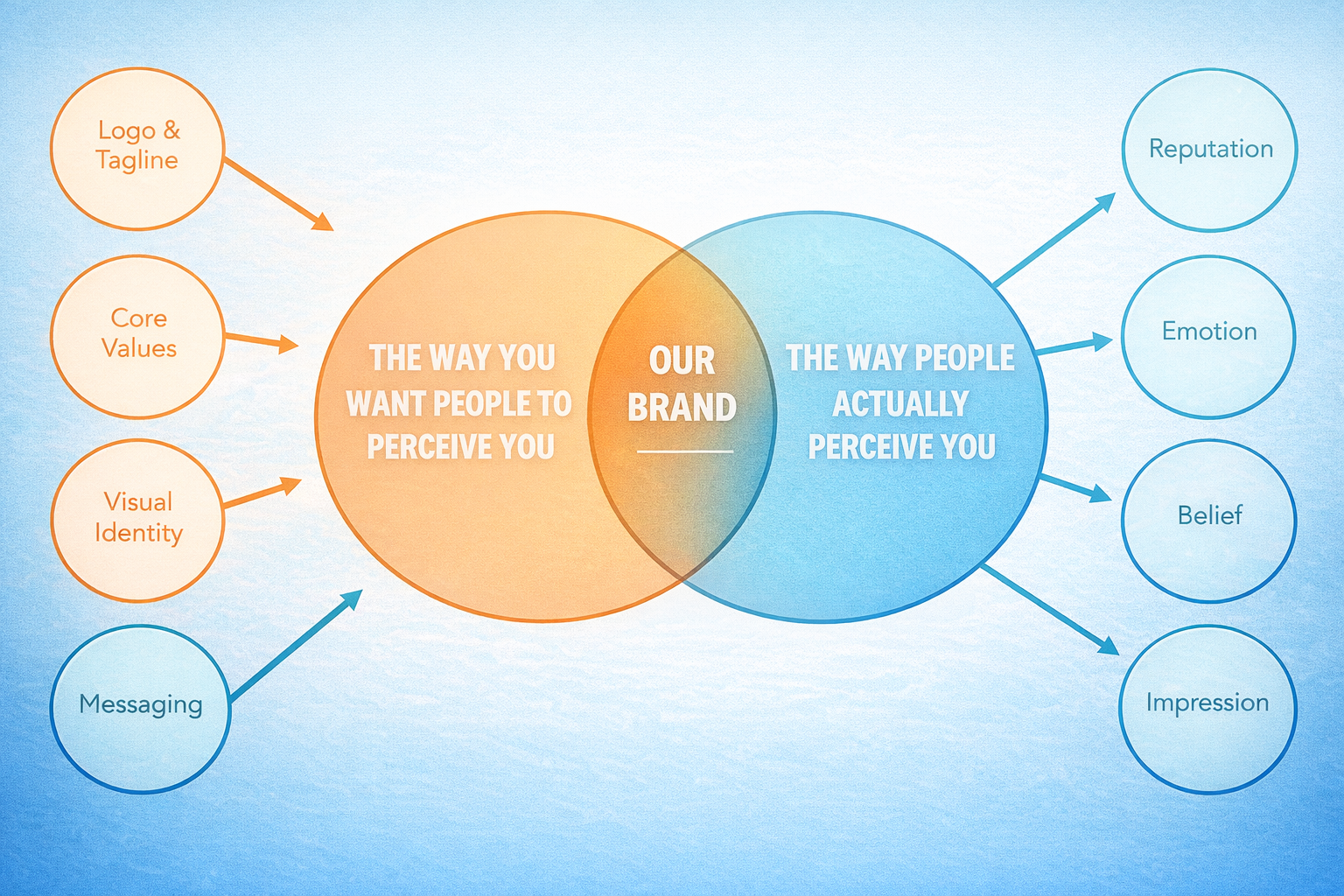
Brand is the intersection of the way you want people to perceive you and the way people actually perceive you.
That intersection exists whether you focus on “branding” or not.
Your Brand Already Exists (Whether You Like It or Not)
Ask a customer, a prospect, and one of your own employees:
“When you think of us, what comes to mind?”
You’ll get some combination of:
Feelings (helpful, slow, expensive, worth it, confusing)
Stories (“They really helped us during COVID,” “They ghosted us after the sale”)
Snap judgments (“They’re for bigger practices,” “They’re buttoned-up,” “They’re scrappy”)
That’s your brand. Not the hex code in your style guide.
If what they say back doesn’t match what you wish your brand stood for, the work isn’t to tweak the logo. It’s to change the experiences that create those impressions.
Brand Starts on the Inside
Many people go to work every day not really knowing why—other than to collect a paycheck and survive the meeting calendar.
Work can be more meaningful than that. It should be.
If your own people can’t answer:
Why do we exist?
Who do we really serve?
What would the world miss if we disappeared?
…you don’t have a brand. You have a business with a logo.
Internal clarity isn’t a “nice to have.” It’s what turns:
Random acts of customer service into a recognizable style
Individual decisions into a consistent experience
Employees into believable storytellers instead of script-readers
Values Only Matter If They Cost You Something
Every company has values on a wall or in a slide:
Integrity
Innovation
Teamwork
Excellence
The problem is none of that differentiates you. No one is out there proudly saying, “Our values are mediocrity and mild deception.”
Brand-level values are specific enough that:
They drive tough choices
They rule certain customers out
They give employees a way to say “we don’t do it that way here”
If your values never cause you to walk away from a deal, change a process, or fire a vendor, they’re not values. They’re wallpaper.
Brand Is Built in the Small Moments
You don’t build a brand at a big launch event. You build it:
In how quickly you fix a bug
In how you answer the phone when a customer is angry
In whether your bill matches what you promised
In how you handle mistakes—yours and theirs
Over time, those moments stack up in the minds of your audience into a simple, emotional conclusion:
“We trust them.”
“We don’t.”
That’s brand.
Design Still Matters—But as a Multiplier
Great design, strong visuals, and clear naming are important. They:
Make you recognizable
Make you easier to remember
Make you feel more “real” and credible
But they’re multipliers, not substitutes.
Good design × bad experience = polished disappointment
Good design × great experience = a brand people seek out and recommend
Bottom line:
Your brand isn’t what you tell people you are.
It’s the story they tell themselves—and each other—after every interaction with you.
Logos, colors, and fonts are just the costume. The brand is the character underneath.