E + R = O: The Formula That Fixed My Work — and My Home
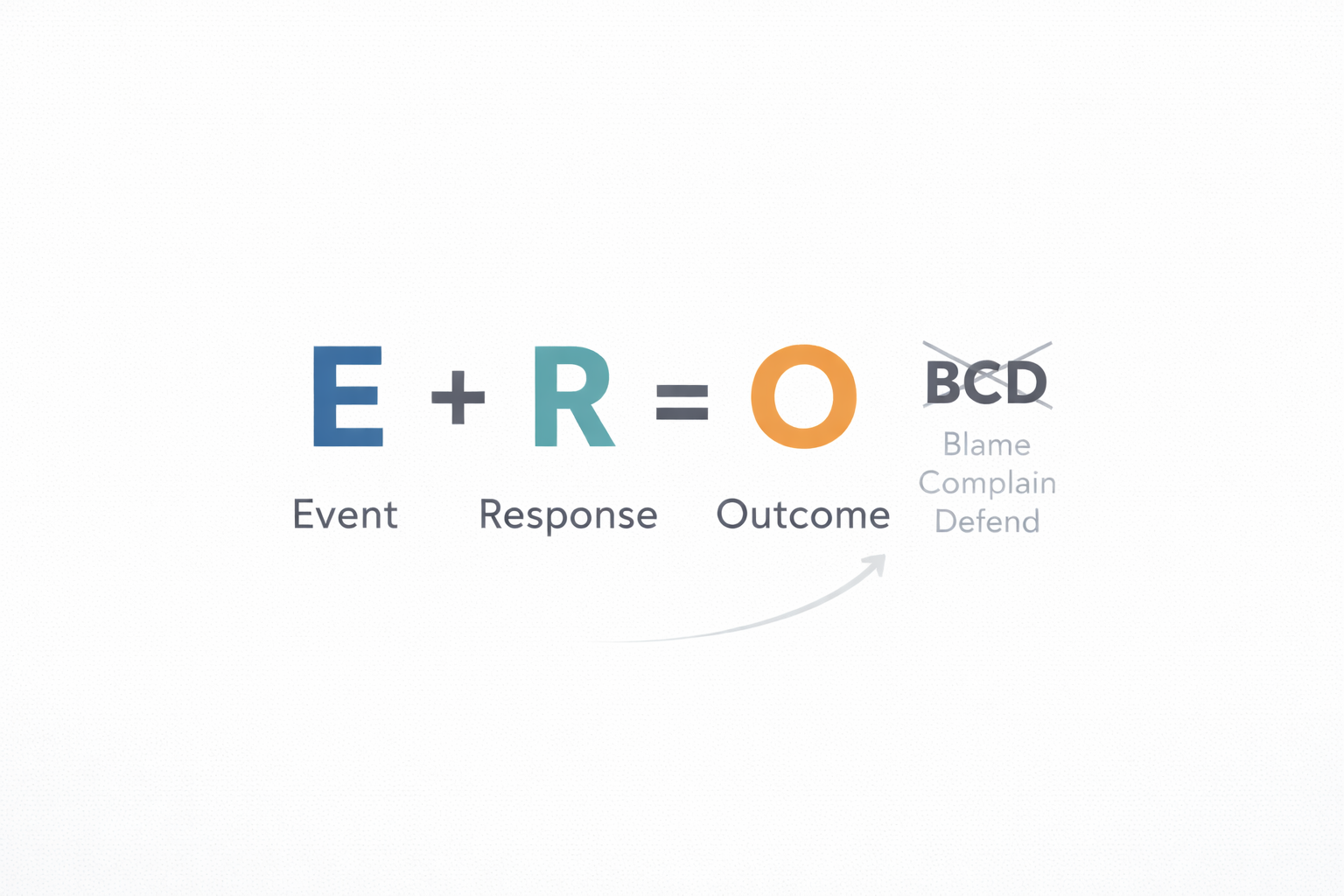
I don’t love “frameworks” for the sake of frameworks. But this one stuck because it’s not a slogan. It’s a filter I can run in real time—in a boardroom, on a sales call, or in my kitchen when everyone’s tired and someone just spilled something.
E + R = O
Event + Response = Outcome
You don’t control every event. You do control your response. And your outcomes are usually the receipt.
The enemy response: BCD
The response that wrecks outcomes most reliably is what Tim Kight calls BCD:
Blaming
Complaining
Defending
BCD feels good for five seconds because it gives your brain a quick exit ramp: It’s their fault. This is unfair. Let me explain why I’m right.
But it’s poison because it burns time and kills learning.
And here’s what matters: BCD isn’t just a work problem. It shows up at home, too.
The home version (where the stakes are actually higher)
Most families don’t need more “communication tips.” They need an operating system for conflict.
Here’s the pattern I’ve seen (and lived):
A kid melts down → someone snaps → the room turns into a courtroom.
“He started it.” (Blame)
“This always happens.” (Complain)
“I didn’t even do anything!” (Defend)
Nobody’s getting a good outcome from that.
So we call it out—gently but directly—because you can’t coach a family (or a team) out of chaos if you pretend chaos is rational.
A few phrases that actually work:
“We’re not doing BCD right now. What outcome do we want?”
“Okay—what’s your next best response?”
“Do you want to be right, or do you want this to get better?”
No BCD doesn’t mean “no emotion”
This is the part people misunderstand.
You’re allowed to be frustrated. You’re allowed to be angry. You’re allowed to need a minute.
No BCD means you don’t park the car in blame/complaint/defense and call it a strategy.
Better options:
Replace blame with ownership: “What can I do next?”
Replace complaining with problem statements + options: “Here’s what’s broken. Here are two paths.”
Replace defending with curiosity: “Help me understand what you expected.”
Why it works professionally
BCD shows up everywhere:
Customer upset? We defend instead of diagnose.
Deal stalls? We blame price instead of messaging.
Project slips? We complain instead of clarifying priorities.
High performers don’t have fewer problems. They have faster, cleaner responses.
Try this in your next stressful situation:
Name the event in one sentence (no emotion words, no blame)
Ask: “What response gives me the best outcome?”
Choose the response you’ll be proud of tomorrow
A simple 7-day challenge
For the next week, keep a note in your phone. Every time you feel BCD rising:
Write the event
Write your default BCD response
Rewrite it as an ownership response
Do the rewritten response
It’s not magic. It’s reps. That’s the point.
CTA: If you want a culture where people move fast, own problems, and don’t spiral into drama—start with E+R=O. It’s the smallest change that creates the biggest shift.