If Your Headline Makes Me Ask “So What Do You Actually Do?”… You’ve Already Lost
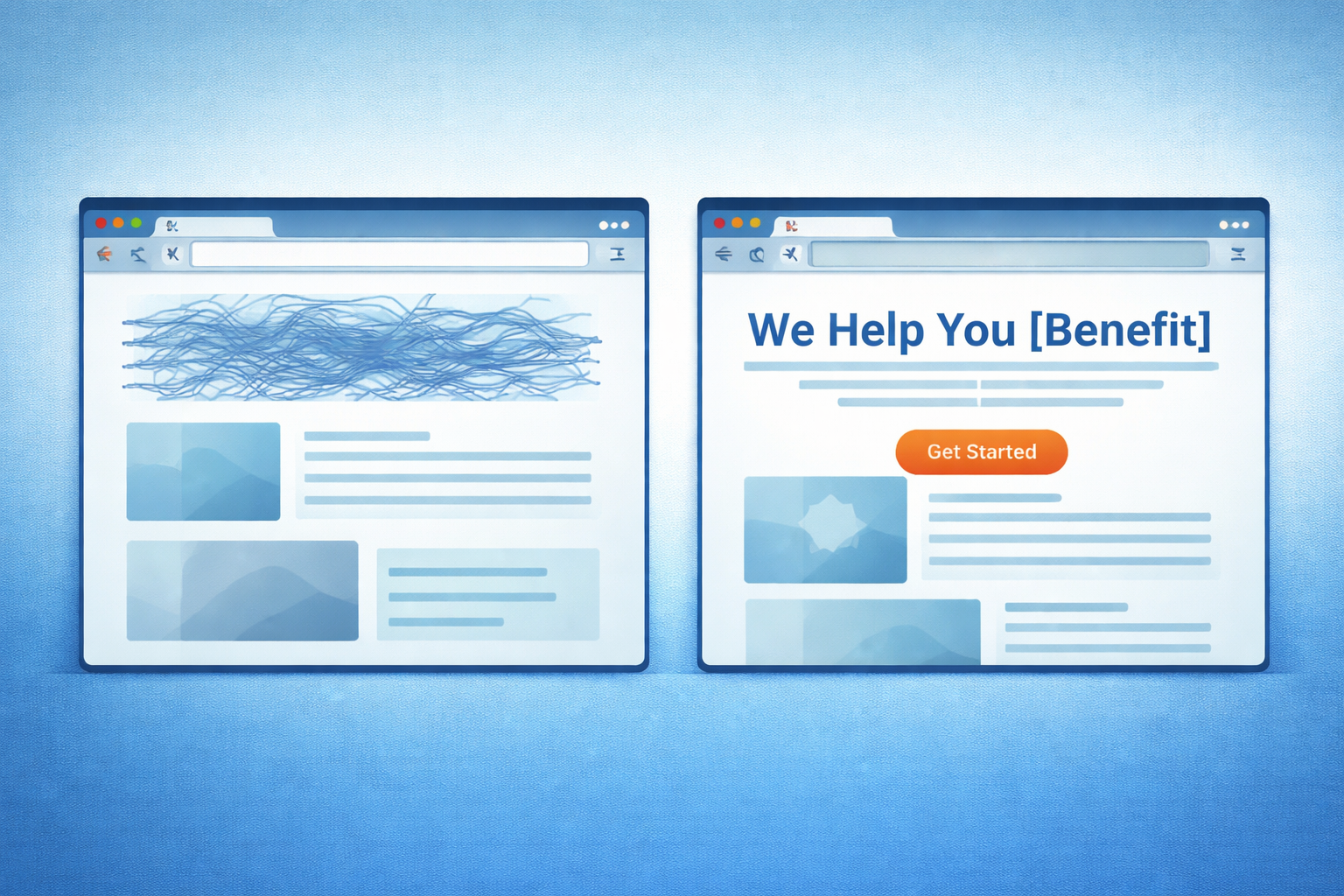
Here’s a fun game:
Go to ten random B2B websites and try to answer one simple question:
“In one sentence, what does this company actually do?”
You’ll get gems like:
“We unlock the power of data-driven transformation.”
“A next-generation platform for scalable experiences.”
“Reimagining the future of work.”
Cool. For who? To do what? Instead of what?
If your headline leaves your ideal buyer squinting and guessing, you’ve already lost them.
Clever Is Optional. Clarity Is Not.
Headlines are where marketers try to impress each other and accidentally repel customers.
You get:
Vague metaphors
Inside jokes
Jargon salad
The problem isn’t that it’s “creative.” The problem is: it doesn’t answer the only question your visitor actually has:
“Is this for someone like me, and does it solve a problem I actually care about?”
A good headline does three things fast:
Names the audience (explicitly or implicitly)
Names the problem or desired outcome
Signals the category enough that I know what lane you’re in
Example:
Bad: “Reinventing patient engagement.”
Better: “We help orthopedic practices get more of their existing patients back into care—without adding staff.”
If Your ICP Can’t Repeat It, It’s Too Complicated
I use a simple test:
Could a reasonably smart sales rep at your target customer repeat your headline in their own words after seeing it once?
If not, it’s too cute.
The goal is to give them a portable explanation they can use internally:
“They’re the guys who help us reduce no-shows.”
“It’s basically a virtual health coach for our post-op patients.”
“They help us get more revenue from the patients we already have.”
Your headline isn’t just for the website. It’s giving language to your future champions.
Jargon Hides Weak Positioning
Most jargon-heavy headlines are trying to cover for one of two things:
The company does too many different things and doesn’t want to commit to one
The company hasn’t made a hard decision about who they’re really for
So instead of saying:
“We help X kind of company do Y very specific thing better than Z alternative”
…they say:
“We enable enterprises to unlock transformational capabilities.”
If you can’t explain it simply, it’s not because your product is too sophisticated. It’s because your positioning is fuzzy.
Fix the positioning, then the language gets easy.
Start with the Conversation, Not the Tagline
If you’re stuck, stop staring at the blank page.
Go talk to:
Customers you love
Deals you recently won
Deals you recently lost
Ask them:
“What were you hoping we would help you with?”
“If you were recommending us to a colleague, what would you say?”
“If we disappeared tomorrow, what would you miss most?”
Steal their words. You will not improve on the way real buyers explain their own problems and wins.
The Two-Headline Rule
One practical trick:
Headline #1 (Hero): Clear, simple, almost boringly obvious
Headline #2 (Subhead): Slightly more detail—how you do it, for whom, in what context
Example:
Hero: “Get more of your existing orthopedic patients back into care.”
Subhead: “Prescribe FIT is a virtual health coaching program that helps practices increase post-op visits, improve outcomes, and grow revenue without adding staff.”
That’s it. No poetry. Just a useful answer to, “So what do you actually do?”
Bottom line:
If your headline needs a paragraph of explanation, it’s not a headline. It’s a riddle.
Stop trying to sound big. Try to sound true.