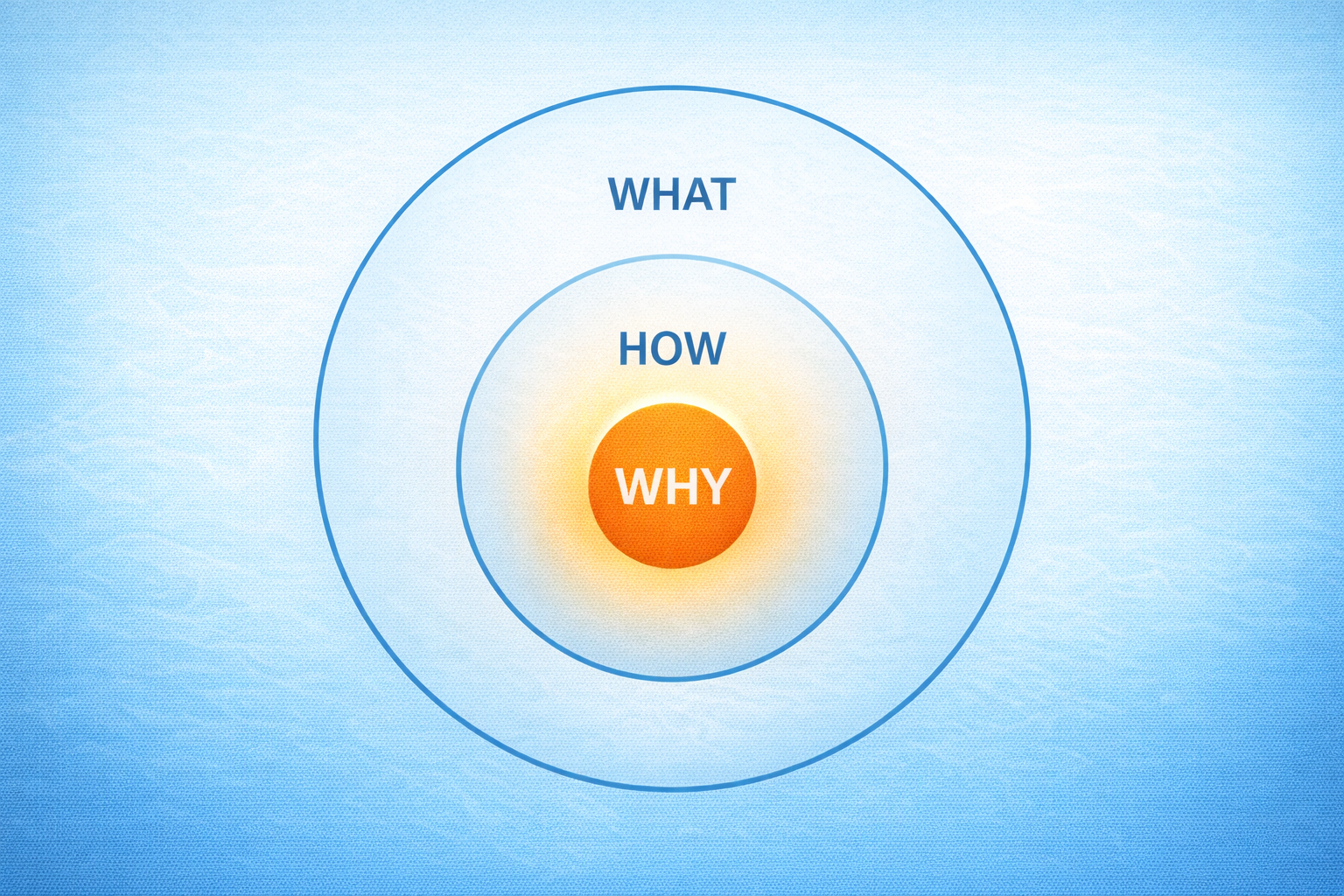
There’s a quote you’ve probably heard a hundred times:
“People don’t buy what you do, they buy why you do it.”
Simon Sinek’s Start with the why TedTalk about the Golden Circle has been replayed in every boardroom and offsite for more than a decade. It’s easy to roll your eyes at it now.
But underneath the overuse, the core idea is still right:
WHY – Your purpose, belief, reason for existing
HOW – The way you behave, build, and deliver
WHAT – The actual products and services you sell
Most companies communicate in the wrong direction. They start with what, occasionally gesture at how, and almost never articulate a real why.
Why Matters (Especially When You’re Not the Only Option)
In almost every B2B category, nobody has a monopoly on features anymore.
Your competitors can:
Copy your UI
Match your price
Borrow your playbook
What they can’t easily copy is your reason for doing this in the first place.
That “why” shows up in:
The trade-offs you’re willing (and not willing) to make
The customers you say “no” to
Where you invest your time, care, and attention
If your “why” is just “maximize shareholder value” or “increase profits,” don’t be shocked when your messaging sounds identical to everyone else’s.
But Your “Why” Has to Connect to Their “Why”
Here’s where a lot of companies get it wrong.
They treat the why as an internal pep talk:
“We believe in innovation.”
“We exist to empower businesses.”
“We’re passionate about customer success.”
No one is against any of that. But none of it explains why a real buyer, with a real problem and a real boss, should care.
Your why has to intersect with the customer’s fundamental buying motive (FBM):
Their fear (missing targets, losing patients, wasting budget)
Their ambition (growth, reputation, impact)
Their constraints (time, staff, resources)
It’s not enough to have a noble origin story. Your why has to translate into a clear WIIFM for each target persona:
“We exist to make sure you never sit in a QBR trying to explain why your marketing didn’t move the needle.”
“We exist to help orthopedic surgeons get better outcomes without burning out their staff.”
That’s where your why becomes more than a line on the About page.
How to Actually Use the Golden Circle
Instead of arguing about slogans, use the Golden Circle as a working tool.
Write your why in one or two plain-English sentences.
No jargon. No “innovative solutions.” Say why you give a damn.Define your how as a handful of concrete behaviors.
“We respond to every customer within X hours.”
“We don’t lock people into long-term contracts.”
“We’ll tell you if we’re not the right fit.”Make your what stupidly clear.
“We sell cheap widgets to local businesses.”
“We offer fractional CMO services to SMBs.”
“We provide software to manage sales pipelines.”
Then sanity check everything:
Does our homepage reflect this?
Do our sales decks reflect this?
Do our recruiting pitches reflect this?
Would our best customers nod along if they read it?
If not, go back and tighten until the inside and outside match.
Don’t Hide the What Behind a Vague Why
One warning: some teams swing too far the other way.
They fall in love with lofty “why” language and bury the actual product.
You end up with:
“We’re on a mission to redefine what’s possible in healthcare.”
Okay. As what?
Software? Services? Training? A media company?
Your why should frame the conversation, not replace the basics.
Lead with:
Why you care
Why this matters now
Why the status quo is unacceptable
Then clearly state:
What you actually do
How you do it differently
What that means for me
Bottom line:
Starting with why is powerful. It forces you to get honest about what you believe and who you’re really for.
But the work isn’t just to craft a beautiful sentence.
The work is to connect your why to the customer’s why, then line up your how and your what so everything points in the same direction.