Stop Saying “It’s Too Long”: Design for Skimmers and Deep Divers
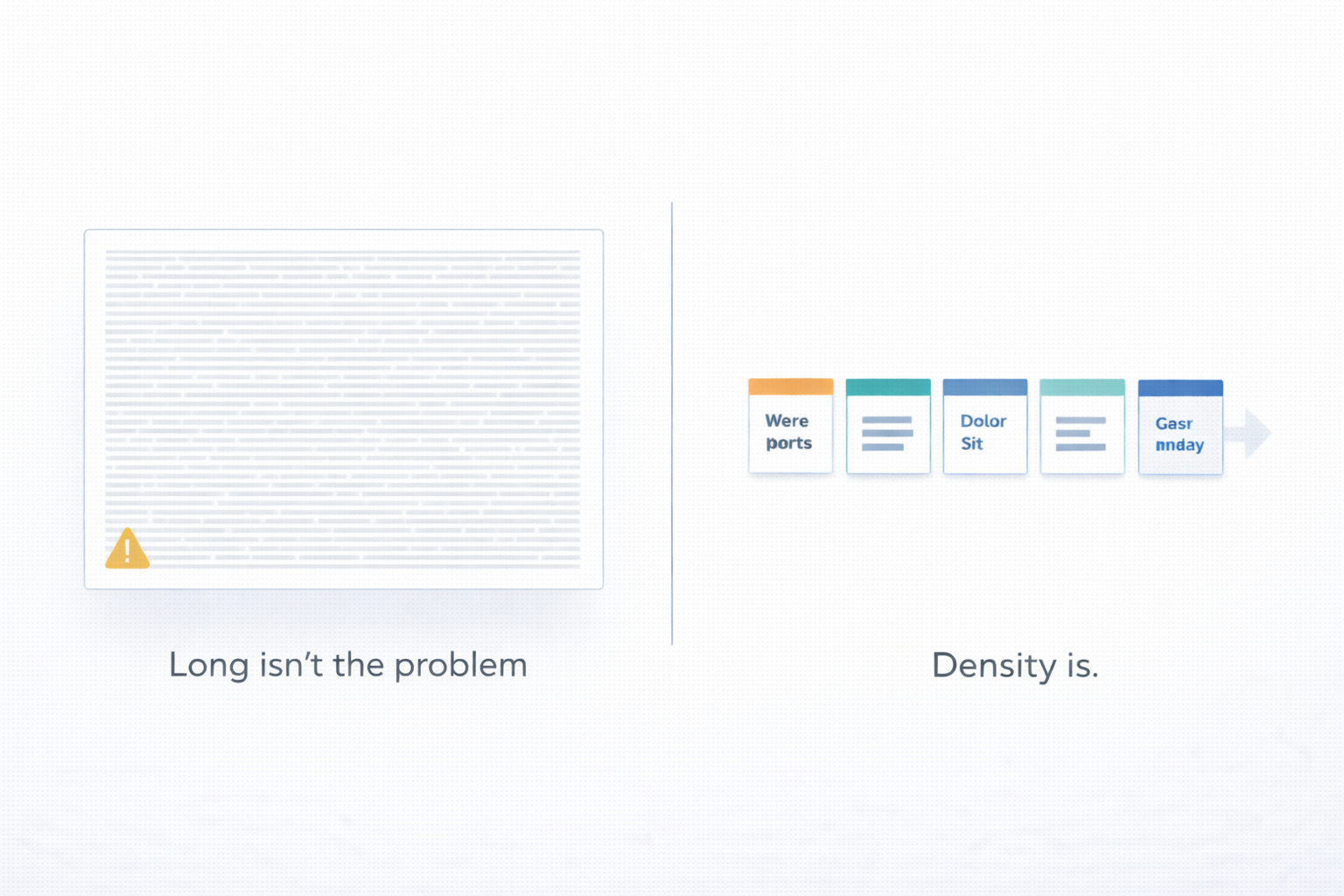
I’m going to say the quiet part out loud:
“It’s too long” is usually lazy feedback.
People can stop reading whenever they want.
They can stop watching whenever they want.
They can stop flipping slides whenever they want.
Length isn’t the problem.
Density is the problem. Structure is the problem. Momentum is the problem.
The goal depends on the content
A blog, book, article, movie? The goal is: keep them engaged long enough to finish (or get value).
Marketing content? The goal is: get the point across and persuade action.
Different job. Different design.
The real rule: always make the next step obvious
If there is a clear CTA visible early and often, your content can be as long as it needs to be to persuade.
Landing page example:
CTA above the fold
CTA after proof
CTA after objections
CTA at the bottom
(bonus) sticky CTA
That’s not “pushy.” That’s good UX.
Long content wins when it’s built for exit
Here’s the framework I use:
Point up top (headline + subhead + 3 bullets + CTA)
Scannable structure (headers that tell the story)
Depth on demand (proof for those who need it)
CTAs throughout (for the ready buyers)
This serves:
headline buyers
proof buyers
detail buyers
…without making separate assets for each persona.
Now: decks
I love big decks.
A deck with 75 slides isn’t “too long.”
It depends on how you run it.
If you spend 5 seconds per slide, 75 slides is 6 minutes.
144 slides is 12 minutes.
That’s fast. That’s momentum. That’s how attention works now.
The real enemy: 50-word slides
Stop designing slides like documents.
If you need 50 words, that’s speaker notes—not a slide.
Better:
1 idea per slide
5–8 words max on most slides
big type
relentless pacing
let the speaker do the explaining
If you want people to stay with you, don’t cram. Move.
A simple test
If someone says “too long,” ask:
“Where did you feel lost?”
“Where did you want to bail?”
“What was unclear?”
“What did you want sooner?”
Because “too long” is rarely about length.
It’s about friction.
CTA: If your content is getting “too long” feedback, don’t automatically cut. First: restructure, add momentum, and make the CTA unavoidable.